By Ruth Abbey Gita-Carlos
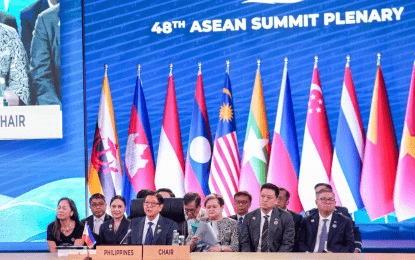
MANILA – President Ferdinand R. Marcos Jr. capped the week with fruitful outcomes of the Philippines’ successful hosting of the Association of Southeast Asian Nations (ASEAN) engagements in Cebu, complemented by the nationwide rollout of expanded government aid, continued efforts toward infrastructure development, and stronger military capability.
Marcos flew to Cebu on Wednesday for the 48th ASEAN Summit and Related Summits, which formally opened at the Mactan Expo Center in Lapu-Lapu City on Friday.
The annual assembly of Southeast Asian leaders, hosted by the Philippines this year, gave Marcos the political leverage in articulating the country’s stance on global and regional matters concerning the 11-man regional bloc.
In his opening remarks, he called for collective efforts to ensure regional energy security and resilience, promote food security, and safeguard ASEAN nationals, anchored on the member-states’ shared commitment to peace, stability, and prosperity.
Marcos said that uncertainty and heightened geopolitical tensions aggravated by the Middle East conflict serve as a “stark reminder” for Southeast Asian nations to take immediate action and pursue “practical cooperation” to address challenges faced by the region.
He led a series of activities, holding meetings, a working lunch, and a Retreat Session with fellow ASEAN leaders, discussing various issues, including the ongoing tensions in the Middle East, the humanitarian crisis in Myanmar, climate change, and maritime concerns.
The summit helped the Philippines advance its urgent and interrelated priorities, yielding tangible outcomes, as the regional bloc agreed to establish mechanisms for fuel sharing, keep markets “open and predictable” to strengthen intra-ASEAN trade, and enhance cooperation to deliver timely support for Southeast Asian nationals in need.
Marcos also announced the adoption of several key documents, including the ASEAN Leaders’ Declaration on Maritime Cooperation, ASEAN Declaration on the Empowerment of Youth in Climate Action and Disaster Resilience, and the ASEAN Leaders’ Statement on the ASEAN Convergence on Disaster Response.
He said ASEAN acknowledged that “the work is far from over” and vowed to continue working together to chart a “peaceful, prosperous, and people-centered” future.
Marcos ended the summit with a gala dinner with his fellow ASEAN leaders, reminding them that unity and sustained cooperation is key to regional stability and prosperity.
Pre-summit activities
Ahead of the formal opening of the summit, Marcos on Thursday chaired the Special Brunei Darussalam-Indonesia-Malaysia-Philippines East ASEAN Growth Area Summit, a strategic forum aimed at enhancing connectivity and economic cooperation within the Southeast Asian subregion.
Marcos also held a bilateral meeting with Vietnamese Prime Minister Le Ming Hung in Cebu, where they agreed to establish a “long-term rice trade mechanism” aimed at strengthening food security cooperation between the Philippines and Vietnam amid global supply concerns.
He also had a trilateral meeting with Cambodian Prime Minister Hun Manet and Thai Prime Minister Anutin Charnvirakul, with Marcos intervening as peacemaker between the two leaders amid their long-running border dispute.
Joined by First Lady Liza Araneta-Marcos, the President hosted a dinner for his fellow regional leaders at Shangri-La Mactan, Cebu on the eve of the 48th ASEAN Summit and Regional Meetings.
Nationwide rollout
Before getting busy with ASEAN-related activities, Marcos spent time fulfilling his promise to bring government services closer to communities by leading the Metro Manila-wide launch of Bawat Bayan, Makikinabang Program on Wednesday.
The flagship social protection program, aimed at providing food and financial assistance to vulnerable sectors with the help of local governments, gained momentum this week as it was implemented in four cities in the country’s metropolis – Muntinlupa, Las Piñas, Parañaque, and Pasay.
About 1,900 families from Muntinlupa City received 10-kg. rice assistance, while 45 scholars were granted PHP20,000 worth of educational aid. A total of 31,000 families from the city are expected to benefit from the program.
Marcos visited the four cities to interact with the so-called presidential scholars, distribute rice subsidies to eligible beneficiaries, and hand over the PHP200,000 in cash assistance to each village from the four Metro Manila cities.
In a speech delivered in Las Piñas City, Marcos vowed higher allocations for the Local Government Support Fund (LGSF) and the Socio-Civic Projects Fund (SCPF) to sustain the faster delivery of services at the grassroots level.
The LGSF provides financial assistance to local government units to support priority development programs and projects, while the SCPF funds community-level initiatives, including education support for scholars.
A similar event was held in General Trias, Cavite on Monday.
Monitoring Mayon Volcano’s unrest
Before the simultaneous rollout of the expanded aid program, Marcos on Thursday presided over a situation briefing with key government agencies at Malacañang Palace in Manila.
During the meeting, he ordered a swift and coordinated response to the continuing unrest of Mayon Volcano.
Evacuation operations, relief distribution, and medical assistance for affected families remain underway, as the government continues to monitor communities affected by heavy ashfall in Albay.
Joint maritime drills
Marcos also observed the joint maritime strike drills conducted under Balikatan 41-2026 at Camp Aguinaldo in Quezon City.
He witnessed the Joint Task Force Maritime Strike, where Philippine and United States (US) forces carried out coordinated operations to detect, track, and engage simulated maritime threats.
Balikatan 41-2026 is considered among the largest iterations to date, with the participation of thousands of troops, not only from the Philippines and the US but also from other allied nations.
Infrastructure development
On Monday, the President inaugurated the 7.88-km. Cavite-Laguna Expressway (CALAX) Subsection 3, which extends the expressway to the Governor’s Drive Interchange in General Trias, Cavite.
The new segment is expected to ease congestion and cut travel time between Biñan, Laguna and General Trias, Cavite from one hour to just 26 minutes, further strengthening South Luzon’s transport network.
The project is also seen to make travel to Metro Manila faster and more convenient.
CALAX Subsection 3 will be free for all classes of vehicles for one month.
Healthcare expansion
During the Bawat Barangay Makikinabang event in General Trias, Cavite on Monday, Marcos announced the planned groundbreaking of a new Philippine General Hospital (PGH) branch in Carmona, Cavite in May.
The new PGH facility will have a 200-bed capacity designed to provide quality medical services for Caviteños and neighboring provinces.
Marcos said the hospital project reflects the administration’s commitment to expanding healthcare services. (PNA)