By Darryl John Esguerra
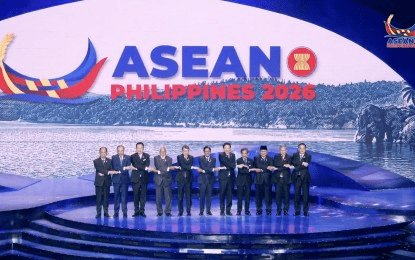
LAPU-LAPU CITY, Cebu – President Ferdinand R. Marcos Jr. called on his fellow Southeast Asian leaders to stand united and remain resilient amid growing geopolitical and economic uncertainty, as he formally opened the 48th Association of Southeast Asian Nations (ASEAN) Summit and Related Meetings here on Friday.
Speaking before ASEAN leaders at the Mactan Expo Center, Marcos said the region is facing a “defining moment” as conflicts and global disruptions continue to affect economies, livelihoods, and regional stability.
“We meet at a time of considerable challenge across our region and beyond,” Marcos said, citing the impact of the volatile situation in the Middle East on ASEAN economies and communities.
“The work of ASEAN must continue, not despite the challenges, but because the times demand our answers to those challenges,” he added.
Marcos said the Philippines recalibrated its ASEAN hosting by scaling down non-essential activities and shifting some meetings online in response to rising energy and economic pressures linked to the conflict in the Middle East.
Despite the adjustments, he said ASEAN remained committed to sustaining cooperation and aligning regional responses through meetings among foreign ministers, as well as those for economics, agriculture, and energy.
The President also emphasized that ASEAN’s strength lies in unity and cooperation, particularly during periods of uncertainty.
“For ASEAN has always drawn its strength not from uniformity but from unity,” he said.
Marcos and First Lady Liza Araneta-Marcos welcomed ASEAN leaders and their spouses upon arrival at the summit venue.
Among those present were Brunei Darussalam Sultan Hassanal Bolkiah, Cambodian Prime Minister Hun Manet, Indonesian President Prabowo Subianto, Lao Prime Minister Sonexay Siphandone, Malaysian Prime Minister Anwar Ibrahim, Singaporean Prime Minister Lawrence Wong, Thai Prime Minister Anutin Charnvirakul, Timor-Leste Prime Minister Xanana Gusmão, and Vietnamese Prime Minister Lê Minh Hưng.
Myanmar was represented by U Hau Khan Sum, permanent secretary of its Ministry of Foreign Affairs. (PNA)