By Darryl John Esguerra
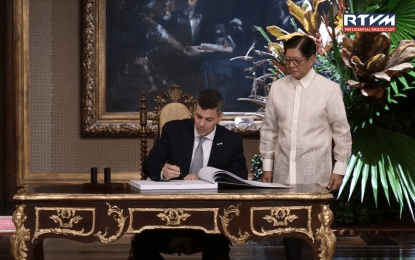
MANILA – Separated by nearly 19,000 kilometers and two oceans, the Philippines and Paraguay on Monday sought to turn geographic distance into a strategic opportunity, as President Ferdinand R. Marcos Jr. and Paraguayan President Santiago Peña moved to deepen political, economic and regional ties.
Inside the Malacañan Palace in Manila, the two leaders spoke not only of bilateral trade and investment, but of connecting Southeast Asia and South America, two regions increasingly looking beyond their traditional partners.
It is the first visit of a Paraguayan leader to the Philippines. Marcos said he may follow suit.
“Since the Philippines and Paraguay established diplomatic relations 63 years ago, this is the first presidential visit ever made by either leader of our two countries,” Marcos said during a joint press statement.
“And since Paraguay has taken the first step, I think it is important that the Philippines soon return the favor.”
The visit comes at a significant geopolitical moment for both countries. The Philippines currently chairs the Association of Southeast Asian Nations (ASEAN), while Paraguay holds the rotating presidency of Mercosur (Southern Common Market), the South American trade bloc composed of Argentina, Brazil, Paraguay, Uruguay and Bolivia.
Peña said Paraguay sees the Philippines as a possible “gateway to Southeast Asia” as his country seeks deeper engagement with ASEAN and broader Indo-Pacific markets.
“At the multilateral level, I am pleased to announce that Paraguay has formally conveyed to the government of the Philippines, in its capacity as chair of ASEAN, its intention to accede to the Treaty of Amity and Cooperation in Southeast Asia,” Peña said.
He described the move as “not a symbolic act” but “a strategic declaration” signaling Paraguay’s commitment to stability and multilateralism in the Indo-Pacific.
International order
Paraguay is also one of the few countries in the world that maintains formal diplomatic relations with Taiwan instead of China, a long-standing foreign policy position reaffirmed by Peña during his recent visit to Taipei.
Beijing considers self-ruled Taiwan a breakaway province.
The Philippines, meanwhile, continues to navigate delicate ties with China amid tensions in the South China Sea while maintaining economic links with Beijing and security ties with the United States.
Despite differing diplomatic configurations with China and Taiwan, both Marcos and Peña emphasized a shared commitment to the rule of law, peaceful dispute resolution and multilateral cooperation.
“Paraguay and the Philippines share a converged vision of the international order, the rule of law, respect for sovereignty, the peaceful settlement of disputes, the promotion of multilateralism, and a commitment to an international system based on clear and predictable rules,” Peña said.
Deepening ties
The two leaders witnessed the signing of agreements on diplomatic training cooperation and reciprocal visa-free travel for ordinary passport holders, aimed at boosting tourism, business and people-to-people exchanges.
Economic cooperation also figured prominently in the talks.
Peña welcomed the Philippines’ opening of its market to Paraguayan beef, pork and poultry imports beginning last year, saying the first shipment had already reached the country.
“We aspire for this trade flow to expand and diversify in a sustained manner, consolidating Paraguay as a reliable supplier of animal protein in Southeast Asia,” he said.
Marcos, meanwhile, raised the possibility of exporting Philippine tuna, sardines and milkfish to Paraguay while encouraging greater business engagement between companies from both countries.
“What came out was a remarkable parallel in the way that our countries are developing ourselves and how we view each of our countries,” Marcos said.
“The Philippines views itself as a gateway to Asia and Paraguay a gateway to Latin America. And that connection, should we make it and should we strengthen it, will be a remarkable boon not only to your country and mine, but also to the regions from where we come from.”
Peña highlighted Paraguay’s expanding Bioceanic Corridor project, a major road and rail infrastructure project that aims to connect Atlantic and Pacific trade routes across South America, positioning the landlocked nation as a logistics hub linking regional markets.
The leaders likewise discussed strengthening ties between ASEAN and Mercosur, with Peña saying both sides agreed to explore a “roadmap” toward deeper engagement in trade, investment and regional value chains.
For Marcos, the historic visit signaled the start of a longer-term partnership between two countries seeking larger roles within their respective regions.
“We were starting to talk not in terms of the short-term or even the medium-term, but in the much, much longer term,” Marcos said. “So we have a great deal of work ahead of us to make sure that we keep that momentum going in our bilateral relations.” (PNA)