By Alexander Lopez
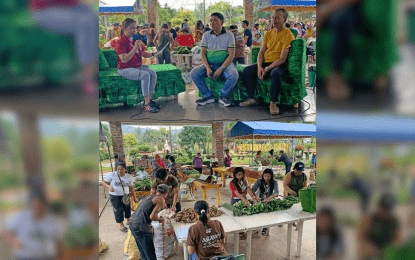
KITCHARAO, Agusan del Norte – A pioneering farm project launched by the local government unit (LGU) has transformed this town’s agricultural landscape, boosting vegetable production, opening market access, and raising household incomes for hundreds of farmers.
Conceived in 2001, the LGU Farm began as a modest training ground for growers and a tourist attraction for visitors nationwide.
Over the years, it has grown into a full-fledged production and marketing hub that continues to anchor the town’s farming community.
“The LGU Farm was established to address the pressing needs of our residents, especially the farmers. These concerns include the lack of income, the minimal job opportunities, and access to livelihood,” Vice Mayor Aristotle Montante said during an interview with government communicators on Tuesday.
Montante was the mayor when the project was started. These days, he works alongside his brother, Mayor Jenry Montante, and Municipal Agriculture Officer Raul Del Agua to further develop the farm and sustain its impact.
Since its founding, the LGU Farm has become a facility complex for agricultural skills and knowledge. It includes an Agricultural Manpower and Development Center with training and seminars, a hydroponics lettuce facility, livestock housing for goats, rabbits, and ostriches, a fishpond, a mini market and souvenir shop, a slaughterhouse, and a warehouse with a motor pool.
A part of Kitcharao’s annual agriculture budget funds the development of the farm.
A livelihood for farmers
In 2023, a breakthrough for the LGU Farm came when the provincial government, under Governor Maria Angelica Rosedell Amante, allocated PHP10 million to establish the Kitcharao Livelihood and Employment Project (KLEP).
KLEP carries two major components – livelihood and labor – designed to provide farmers with added income and a pathway out of poverty.
The funding covered vegetable seeds, fertilizers, farm implements, and training, laying the groundwork for a new chapter in local agriculture.
The first batch of beneficiaries included 116 vegetable farmers who, after receiving support, began planting in the last quarter of 2023.
“Aside from developing their farms, they are also asked to display their harvests twice a week – every Tuesday and Friday – at the LGU Farm for a weekly ‘Tabo’ market activity,” Del Agua said.
The “Tabo” serves as a marketing strategy to enable farmers to transact directly with wholesale buyers, not only from Kitcharao but also from neighboring towns.
“At the ‘Tabo,’ our farmers are assured of high and favorable prices for their products,” Del Agua added.
To reduce costs, LGU vehicles collect harvests from barangays on market days, sparing farmers transportation expenses.
Vice Mayor Montante noted that through the Department of Agriculture’s Kadiwa ng Pangulo program, the town acquired two delivery trucks to help farmers bring their produce to market centers, including the LGU Farm.
Data from the Municipal Agriculture Office show that from 2024 to 2025, the first batch of KLEP beneficiaries produced 126,274.53 kilograms of vegetables.
During that period, sales from the “Tabo” activities reached PHP4,729,690, a clear sign of how the program has reshaped livelihoods in this farming town.
A big help
Teresita Borinaga, 54, a mother of three from Barangay Crossing, is among the first beneficiaries of KLEP. She has developed about two hectares of vegetable farms spread across different locations in town.
“Since 2023, after receiving support from the LGU through the KLEP, I started to grow eggplants, patola, pechay, ampalaya, and cucumber,” Borinaga said.
She noted that her weekly sales during the “Tabo” range from PHP3,000 to PHP5,000, depending on the variety of vegetables she displays.
“We also allocate a portion of our sales to a savings program at the town’s Treasurer’s Office. We can use these savings if we intend to expand our areas to purchase additional seeds and fertilizers,” Borinaga said.
Another farmer-beneficiary, Eladio Montefalcon, 63, a father of seven, has found success by selling wholesale to buyers of his ampalaya and cucumber harvests.
“Since 2023, I have been able to develop around 1 hectare of a vegetable farm devoted to ampalaya, cucumber, okra, and eggplant,” Montefalcon said.
His transactions with wholesale buyers often bring in sales of up to PHP57,000 during the “Tabo.”
In 2025, the LGU Farm also began dispersing livestock to farmer-beneficiaries.
A total of 121 farmers from 11 barangays were the first recipients of the dispersal program last year, which included 29 cattle and 92 goats.
In the same year, an additional 38 farmers were listed under the KLEP program and had started engaging buyers during the regular “Tabo” activities.
“This year, 104 more farmer beneficiaries from our town are joining the KLEP and will receive support to develop their respective vegetable farms,” Montante said. (PNA)