By Ruth Abbey Gita-Carlos
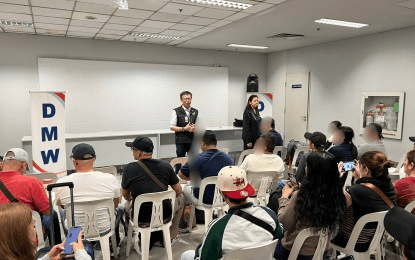
MANILA – The Philippine government has been working “since the first signs of the crisis” in the Middle East, Department of Migrant Workers (DMW) Secretary Hans Leo Cacdac said Sunday (New York time).
In a statement, Cacdac said DMW offices are coordinating with ambassadors and heads of posts from affected Gulf states to ensure the safety of Filipinos living and residing in host countries.
“Our Migrant Workers Offices, working under the guidance of our Ambassadors and Heads of Posts, have been on the ground since the first signs of this crisis,” he said.
“They have been tirelessly coordinating with local authorities, reaching out to OFWs (overseas Filipino workers), identifying service providers, and carefully preparing the appropriate courses of action. We deeply value their work and their sacrifices.”
He issued the statement in response to retired Supreme Court Justice Noel Tijam’s Facebook post, claiming that “the Philippine Government has failed Filipinos stranded in the Gulf region war zone.”
Tijam blasted the Marcos administration’s alleged “bad governance [and] incompetence,” citing its failure to come up with a “workable evacuation plan in place.”
Cacdac said a nation under intense attack such as the United Arab Emirates “must defend citizens, residents and visitors in [its] territory.”
Citing a statement of UAE President Mohamed bin Zayed Al Nahyan, Cacdac said the Gulf state made a commitment to safeguarding the security of citizens, residents, and visitors, while calling for unity and resilience during challenging times.
“After all, it is the UAE that knows and handles the terrain, military and civilian defense strategies, the resources and logistics for providing such safety and protection, and the dynamics of the conflict,” Cacdac said.
He added that the Philippine government’s role is to augment the UAE’s protective efforts through on-site programs and services for OFWs.
“Mainly, this would be in the form of basic needs assistance to OFWs, especially those most adversely affected by the crisis. To date, 9,000 OFWs in all involved countries have been given such onsite assistance,” he said.
Cacdac explained that the “welcoming practice” of the DMW and the Overseas Workers Welfare Administration (OWWA) for repatriated Filipinos at airports has long been part of their mandate.
“This welcoming practice is prevalent during Christmas and New Year’s Salubong of returning OFWs, and in cases of the return of distressed OFWs. During such salubong situations, all forms of post-repatriation assistance are delivered by the DMW-OWWA at holding areas in airports,” he said.
“Our presence at the airport was simply to warmly welcome our OFWs home, and to make sure that assistance from the Philippine government was readily available should they need it upon arrival.” (PNA)