By Joyce Ann L. Rocamora
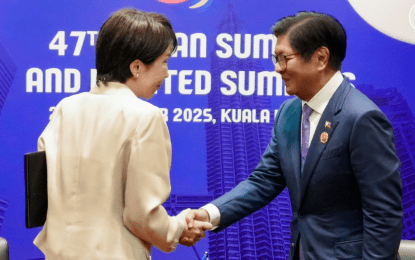
MANILA – President Ferdinand R. Marcos Jr. and his Japanese counterpart Prime Minister Takaichi Sanae agreed to work closely towards supporting the “early de-escalation” in the Strait of Hormuz as the Iranian blockade in the key waterway brings energy crisis across regions.
The two leaders made the agreement during a summit telephone meeting in the evening of March 24.
The Japan Ministry of Foreign Affairs said the two put emphasis on coordination and cooperation with the international community in ensuring the early de-escalation of the situation, with a particular focus on “securing safe navigation in the Strait of Hormuz.”
“President Marcos explained the position and efforts of the Philippines. The two leaders concurred on closely working together toward the early de-escalation of the situation,” it said.
At the Kapihan sa Manila Hotel on Wednesday, Foreign Affairs Secretary Ma. Theresa Lazaro said Marcos was also “very candid” in talking about the situation of the about 2.5 million Filipinos in the Middle East, and emphasized that the government places their safety on top of its priorities.
Beyond the Middle East situation, Lazaro said the two leaders also discussed the possibility of expanding the trilateral Japan-Philippines-United States cooperation.
“It was a very cordial exchange of views,” she said.
Marcos on Tuesday declared a state of national emergency to address potential disruption in fuel supply and stabilize the country’s energy sector.
In Executive Order (EO) 110 signed on March 24, Marcos cited the escalating tensions in the Middle East as a key factor threatening global oil production and transportation, which could affect the Philippines as a net importer of petroleum products.
Disruptions in critical supply routes, including the Strait of Hormuz, may constrain global fuel supply and trigger price volatility, posing risks to the country’s energy security, according to EO 110. (PNA)